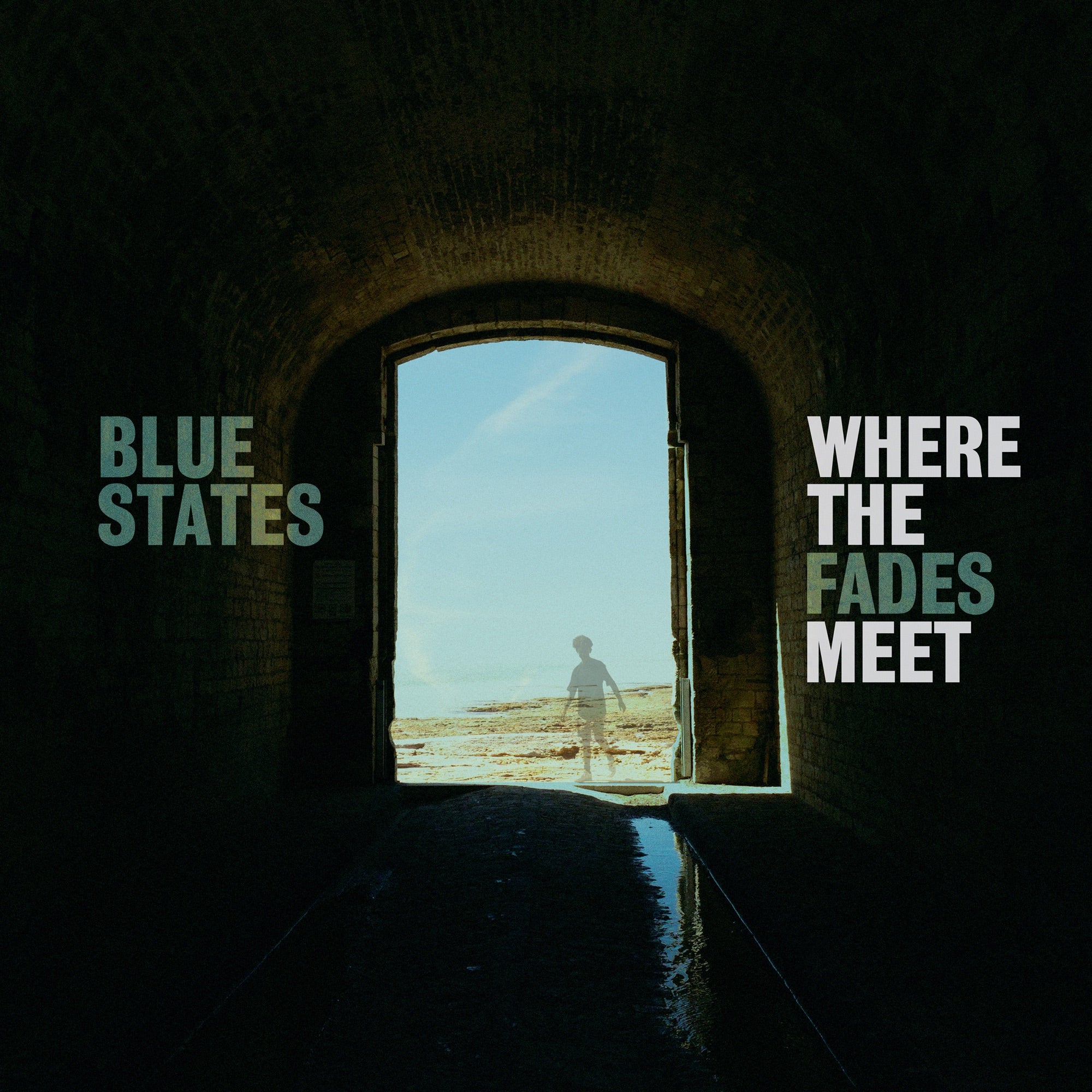
Where the Fades Meet
More than two decades into the ever-evolving world of Blue States, Andy Dragazis returned with album, Where The Fades Meet. Dragazis expands his signature cinematic sounds, placing a six-piece choir at the heart of the record. Continuing with the motif of big, atmospheric, widescreen production, but this time built around the concept of a small choir singing lead vocals in unison, the album transforms intimate songwriting into something communal and immersive.
The album marks another step in the evolution of Blue States, which has morphed over the years from a one-man project, to a live band, and now back to a studio-based solo project. Most of the album was recorded in Dragazis’ London based studio, with the choir and strings tracked separately. “Recording an album with a choir and a string quartet felt like a way of pushing myself both musically and technically – taking me out of my comfort zone” says Dragazis of the record. The choir came together after Dragazis reconnected with Tahita Bulmer (New Young Pony Club) who had collaborated with him on second Blue States album Man Mountain. Bulmer introduced him to vocalist Stacey Dowdeswell. Dowdeswell then helped assemble the six-piece vocal ensemble for the sessions, whose performances were largely recorded live in one take, capturing a raw, unpolished immediacy which adds to the human fragility and sense of presence at the core of the album. Bulmer herself joined the choir, marking a full-circle return to their earlier collaboration on “Man Mountain” more than twenty years ago. Even within the collective, her distinctive voice occasionally rises above the others and briefly takes centre stage. Also featured throughout the album is the acclaimed string quartet The Elysian Quartet.
Where The Fades Meet stands out as one of Blue States’ most expansive and immersive works to date, balancing intricate orchestration with emotional intimacy and blurring the boundary between the personal and the universal.
Original: $46.76
-65%$46.76
$16.37Product Information
Product Information
Shipping & Returns
Shipping & Returns
Description
More than two decades into the ever-evolving world of Blue States, Andy Dragazis returned with album, Where The Fades Meet. Dragazis expands his signature cinematic sounds, placing a six-piece choir at the heart of the record. Continuing with the motif of big, atmospheric, widescreen production, but this time built around the concept of a small choir singing lead vocals in unison, the album transforms intimate songwriting into something communal and immersive.
The album marks another step in the evolution of Blue States, which has morphed over the years from a one-man project, to a live band, and now back to a studio-based solo project. Most of the album was recorded in Dragazis’ London based studio, with the choir and strings tracked separately. “Recording an album with a choir and a string quartet felt like a way of pushing myself both musically and technically – taking me out of my comfort zone” says Dragazis of the record. The choir came together after Dragazis reconnected with Tahita Bulmer (New Young Pony Club) who had collaborated with him on second Blue States album Man Mountain. Bulmer introduced him to vocalist Stacey Dowdeswell. Dowdeswell then helped assemble the six-piece vocal ensemble for the sessions, whose performances were largely recorded live in one take, capturing a raw, unpolished immediacy which adds to the human fragility and sense of presence at the core of the album. Bulmer herself joined the choir, marking a full-circle return to their earlier collaboration on “Man Mountain” more than twenty years ago. Even within the collective, her distinctive voice occasionally rises above the others and briefly takes centre stage. Also featured throughout the album is the acclaimed string quartet The Elysian Quartet.
Where The Fades Meet stands out as one of Blue States’ most expansive and immersive works to date, balancing intricate orchestration with emotional intimacy and blurring the boundary between the personal and the universal.