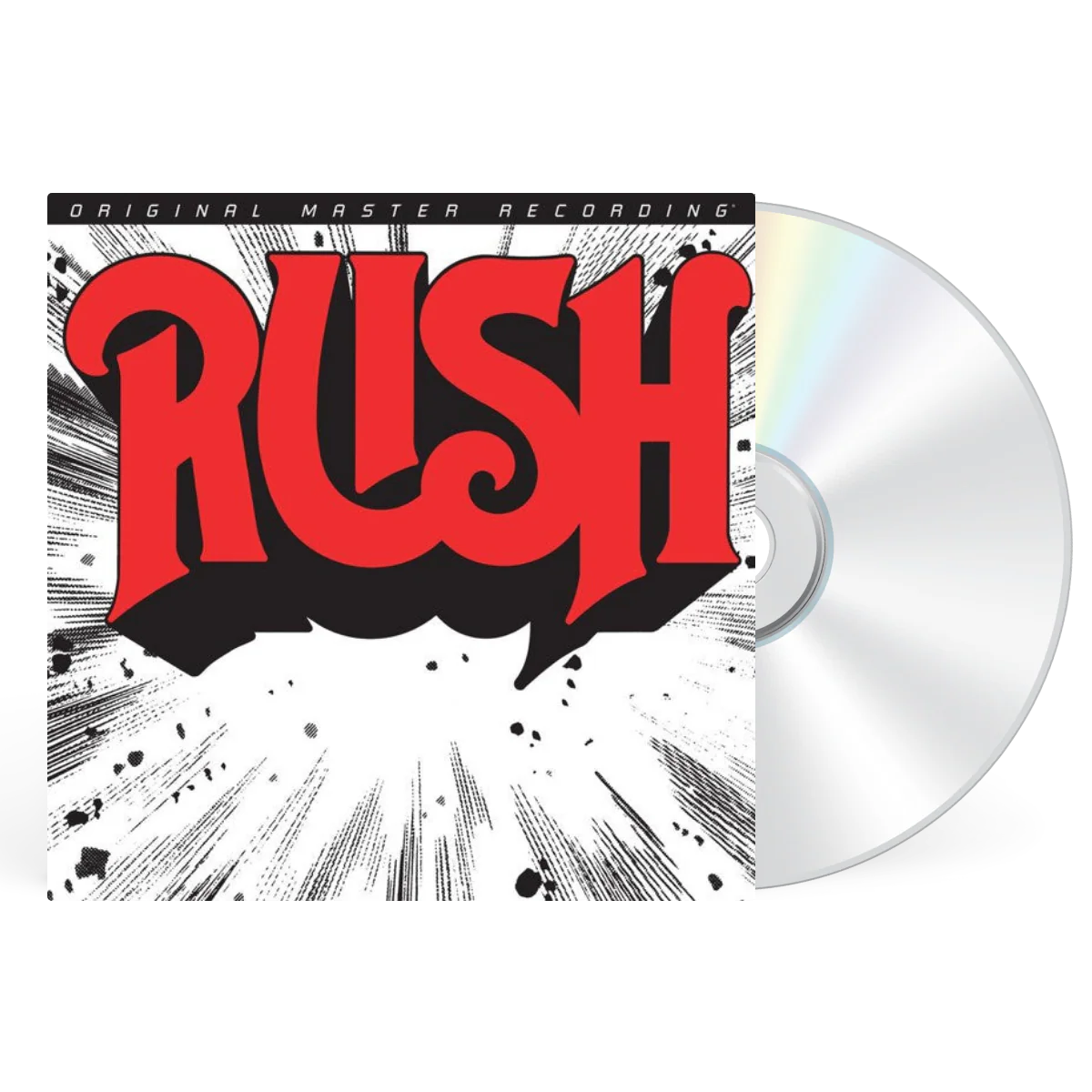
Rush
Rush’s eponymous debut remains unique for being the only entry in the trio’s extensive catalog that doesn’t feature its renowned drummer and lyricist, Neil Peart. That distinction informs the foundational content and independent-minded story of Rush — whose straightforward performances and no-frills songwriting fascinate more than five decades after its original release in March 1974.
Sourced from the original analog master tapes, pressed at Fidelity Record Pressing, and housed in a Stoughton gatefold jacket, Mobile Fidelity's numbered-edition 180g 45RPM 2LP set presents the Canadian group’s self-titled effort in definitive audiophile sound and at 45RPM speed for the first time. Benefitting from superb groove definition, an ultra-low noise floor, and dead-quiet surfaces, this collectible version captures what went down at two Toronto studios with engaging presence, tonal precision, and enhanced dynamics. The wider grooves of the 45RPM pressing also contribute to improved tracking and high-frequency preservation.
That means the reaches of Geddy Lee’s signature high-pitched vocals can be experienced close to the manner the band desired when the members originally walked into Eastern Sound Studios in 1973 for its first session with producer Dave Stock. Though those initial recordings suffered from disappointments ranging from thinness, lightness, and out-of-phase problems, Rush — knowing they had to be corrected given the high stakes tied to first impressions — reconvened with engineer Terry Brown at Toronto Sound later that fall.
The drastic improvements Brown made can be heard like never before. His crucial overdubs, as well as Rush’s laying down of three new songs, put everything back on track. The fullness, body, and extension of the instruments — at this stage, limited to guitars, bass, and basic drums — emerge with newfound clarity and perspective. Afforded revealing separation, soundstaging, and imaging, the music comes across with a scale and size true to the asteroid-burst-like cover art and group’s “Energized Rock” motto.
Far from wishful thinking, Rush’s slogan developed out of its reputation as a formidable live act that helped build its chemistry across the better part of five years at high-school dances, bars, small arenas, and most any place that would host a rock ‘n’ roll group yearning to do more than cover songs. Such ambition led Rush to the studio to release an LP without label support. Created in tandem with its management team, the band’s Moon Records imprint pressed 3,500 copies of Rush largely for sale in its native Canada.
Though the album gained traction, particularly amid the group’s home base of Ontario, an add by Cleveland radio station WMMS served as the fortuitous circumstance that ultimately put Rush on mainstream radars. Drawn to the song’s blue-collar lyrics and aspirational themes, DJ Donna Halper put “Working Man” in rotation after getting a copy of the record from an A&M Records executive who befriended the band. She then attended to the phones as listeners called up asking about Rush’s identity and where they could get a copy of the LP.
Shortly after Rush blew up in Cleveland, Mercury Records stepped in to reissue the album and distribute it internationally. The spirit of radio — along with the satisfying combination of direct arrangements, blues-spiked hard rock, Lee’s trademark vocals, and Alex Lifeson’s strong guitar riffs and crisp leads — sent Rush on its way. One more dramatic twist of fate conspired to transform the band into what we know it today.
Despite his solid playing on deep cuts such as “In the Mood,” “Need Some Love,” and the complex acoustic-to-electric suite “Before and After” that hints at directions the band would soon pursue, drummer John Rutsey would bow out in late July 1974 — just before the Mercury version of the gold-certified Rush landed. Owing to a combination of health issues and incompatibilities with Lee and Lifeson’s musical interests, his departure paved the way for Peart, whose audition so impressed his mates that he was hired that night.
Lee, Lifeson, and Peart would change the course of music and cultural history. Rush is how it all begins.
Original: $86.85
-65%$86.85
$30.40Product Information
Product Information
Shipping & Returns
Shipping & Returns
Description
Rush’s eponymous debut remains unique for being the only entry in the trio’s extensive catalog that doesn’t feature its renowned drummer and lyricist, Neil Peart. That distinction informs the foundational content and independent-minded story of Rush — whose straightforward performances and no-frills songwriting fascinate more than five decades after its original release in March 1974.
Sourced from the original analog master tapes, pressed at Fidelity Record Pressing, and housed in a Stoughton gatefold jacket, Mobile Fidelity's numbered-edition 180g 45RPM 2LP set presents the Canadian group’s self-titled effort in definitive audiophile sound and at 45RPM speed for the first time. Benefitting from superb groove definition, an ultra-low noise floor, and dead-quiet surfaces, this collectible version captures what went down at two Toronto studios with engaging presence, tonal precision, and enhanced dynamics. The wider grooves of the 45RPM pressing also contribute to improved tracking and high-frequency preservation.
That means the reaches of Geddy Lee’s signature high-pitched vocals can be experienced close to the manner the band desired when the members originally walked into Eastern Sound Studios in 1973 for its first session with producer Dave Stock. Though those initial recordings suffered from disappointments ranging from thinness, lightness, and out-of-phase problems, Rush — knowing they had to be corrected given the high stakes tied to first impressions — reconvened with engineer Terry Brown at Toronto Sound later that fall.
The drastic improvements Brown made can be heard like never before. His crucial overdubs, as well as Rush’s laying down of three new songs, put everything back on track. The fullness, body, and extension of the instruments — at this stage, limited to guitars, bass, and basic drums — emerge with newfound clarity and perspective. Afforded revealing separation, soundstaging, and imaging, the music comes across with a scale and size true to the asteroid-burst-like cover art and group’s “Energized Rock” motto.
Far from wishful thinking, Rush’s slogan developed out of its reputation as a formidable live act that helped build its chemistry across the better part of five years at high-school dances, bars, small arenas, and most any place that would host a rock ‘n’ roll group yearning to do more than cover songs. Such ambition led Rush to the studio to release an LP without label support. Created in tandem with its management team, the band’s Moon Records imprint pressed 3,500 copies of Rush largely for sale in its native Canada.
Though the album gained traction, particularly amid the group’s home base of Ontario, an add by Cleveland radio station WMMS served as the fortuitous circumstance that ultimately put Rush on mainstream radars. Drawn to the song’s blue-collar lyrics and aspirational themes, DJ Donna Halper put “Working Man” in rotation after getting a copy of the record from an A&M Records executive who befriended the band. She then attended to the phones as listeners called up asking about Rush’s identity and where they could get a copy of the LP.
Shortly after Rush blew up in Cleveland, Mercury Records stepped in to reissue the album and distribute it internationally. The spirit of radio — along with the satisfying combination of direct arrangements, blues-spiked hard rock, Lee’s trademark vocals, and Alex Lifeson’s strong guitar riffs and crisp leads — sent Rush on its way. One more dramatic twist of fate conspired to transform the band into what we know it today.
Despite his solid playing on deep cuts such as “In the Mood,” “Need Some Love,” and the complex acoustic-to-electric suite “Before and After” that hints at directions the band would soon pursue, drummer John Rutsey would bow out in late July 1974 — just before the Mercury version of the gold-certified Rush landed. Owing to a combination of health issues and incompatibilities with Lee and Lifeson’s musical interests, his departure paved the way for Peart, whose audition so impressed his mates that he was hired that night.
Lee, Lifeson, and Peart would change the course of music and cultural history. Rush is how it all begins.