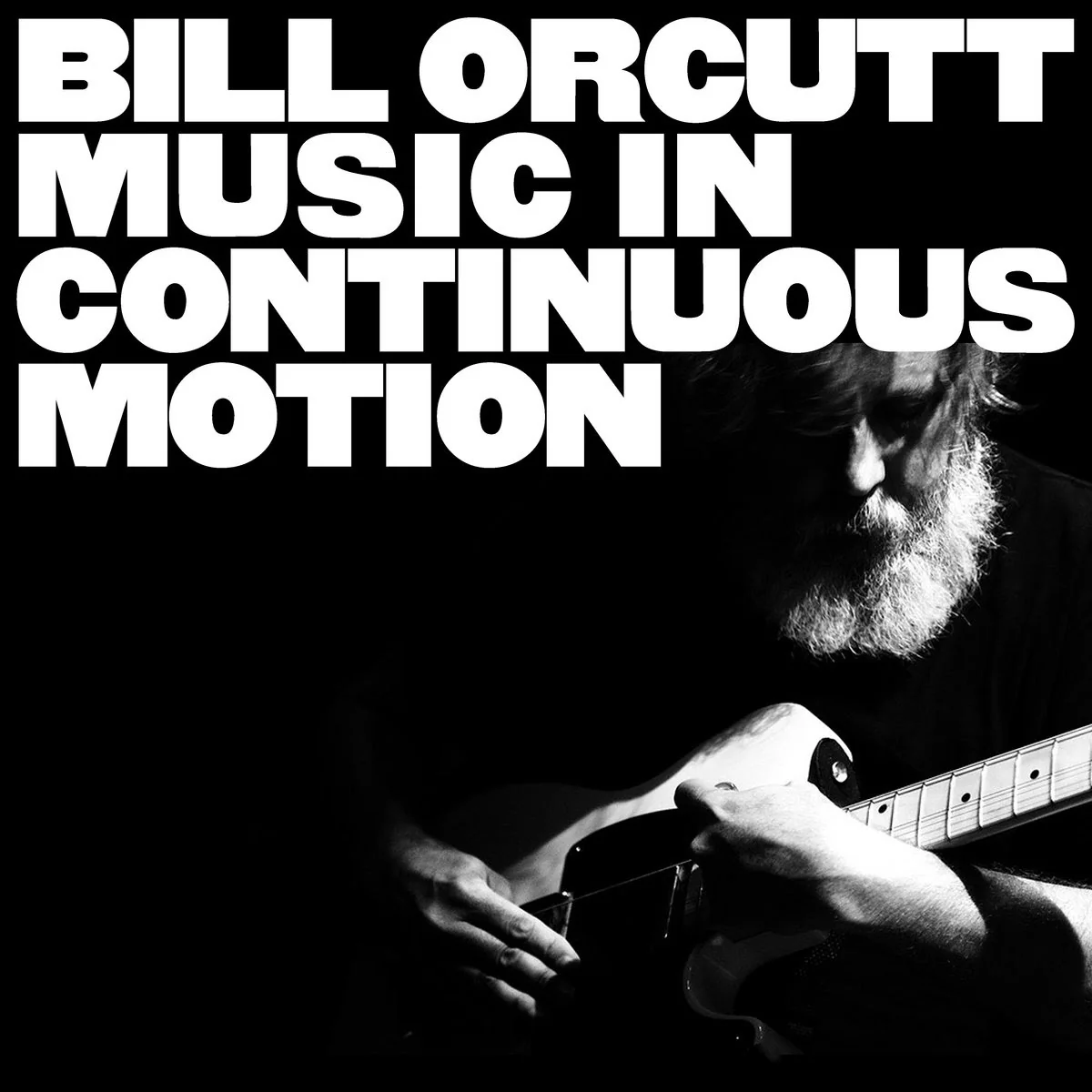


Music in Continuous Motion
Music in Continuous Motion, Bill Orcutt’s latest entry into his 21st-century repertoire of quartet guitar music, pointedly steps away from the cut-and-paste constructivism of Music for Four Guitars into a sonic stratum that's yearningly melodic, resolutely human, and built for performance. Conceived for a 2026 NYC concert, Music in Continuous Motion shares the concision of its predecessor—but rather than the discrete, mechanistic precision of Music for Four Guitars, the tracks on Music in Continuous Motion unify—each song weaving four gleaming threads into the warp and weft of an evolving, complex texture that employs simple, repeating motifs to build new melodies from counterpoint itself. It accomplishes this in the most efficient manner possible: most of these 12 tracks hover around two-and-a- half minutes, each iterating first the substrate, then the melody and its variations, then slamming shut like a clockwork music box.
Based on previous recorded evidence, Orcutt is fond of boundary conditions for his studio guitar records. Much of the time, his launchpad is obvious (The Four Louies, How to Rescue Things); with others, it’s intentionally obscured. When recruiting me to write about each release, he might send me a clue (“This is a bridge pickup record more than a neck pickup record,” Orcutt helpfully offered for Music for Four Guitars). Although any given dispatch is a potential red herring, up until now, each has implied an Oulipian conceit (however obtuse) that at least somewhat determines the outcome. Thus, I was a bit surprised by his statement on Music in Continuous Motion—“The mystery of how [the] same person, same process, same gear produces different results." When pressed, he elaborated that the record features “no triplets,” something I’ve yet to count out to determine for myself.
Whatever overarching form the recording process may have mapped out, the path of the finished album is explicitly poetic. Echoing its predecessor, the song titles, read in sequence, paint fleetingly-glimpsed forms—but in contrast to the distant shapes described in Music For Four Guitars, the present narrative spotlights the dance of polygons momentarily grasped (and then lost) as they spin through space: “Because sharp also smooth,” “And warm to the touch,” “Now nearly gone,” “Yet always moving,” “Impossible to reach.” Ultimately, the key difference between the albums (and what places Music in Continuous Motion in the realm of poetry) is its celebration of movement over immutability, of melody over form, of music as a hot wire to the heart rather than another upped ante in an arms race of inscrutability.—Tom Carter
Original: $26.71
-65%$26.71
$9.35Product Information
Product Information
Shipping & Returns
Shipping & Returns
Description
Music in Continuous Motion, Bill Orcutt’s latest entry into his 21st-century repertoire of quartet guitar music, pointedly steps away from the cut-and-paste constructivism of Music for Four Guitars into a sonic stratum that's yearningly melodic, resolutely human, and built for performance. Conceived for a 2026 NYC concert, Music in Continuous Motion shares the concision of its predecessor—but rather than the discrete, mechanistic precision of Music for Four Guitars, the tracks on Music in Continuous Motion unify—each song weaving four gleaming threads into the warp and weft of an evolving, complex texture that employs simple, repeating motifs to build new melodies from counterpoint itself. It accomplishes this in the most efficient manner possible: most of these 12 tracks hover around two-and-a- half minutes, each iterating first the substrate, then the melody and its variations, then slamming shut like a clockwork music box.
Based on previous recorded evidence, Orcutt is fond of boundary conditions for his studio guitar records. Much of the time, his launchpad is obvious (The Four Louies, How to Rescue Things); with others, it’s intentionally obscured. When recruiting me to write about each release, he might send me a clue (“This is a bridge pickup record more than a neck pickup record,” Orcutt helpfully offered for Music for Four Guitars). Although any given dispatch is a potential red herring, up until now, each has implied an Oulipian conceit (however obtuse) that at least somewhat determines the outcome. Thus, I was a bit surprised by his statement on Music in Continuous Motion—“The mystery of how [the] same person, same process, same gear produces different results." When pressed, he elaborated that the record features “no triplets,” something I’ve yet to count out to determine for myself.
Whatever overarching form the recording process may have mapped out, the path of the finished album is explicitly poetic. Echoing its predecessor, the song titles, read in sequence, paint fleetingly-glimpsed forms—but in contrast to the distant shapes described in Music For Four Guitars, the present narrative spotlights the dance of polygons momentarily grasped (and then lost) as they spin through space: “Because sharp also smooth,” “And warm to the touch,” “Now nearly gone,” “Yet always moving,” “Impossible to reach.” Ultimately, the key difference between the albums (and what places Music in Continuous Motion in the realm of poetry) is its celebration of movement over immutability, of melody over form, of music as a hot wire to the heart rather than another upped ante in an arms race of inscrutability.—Tom Carter